By Christina Ison August 19, 2026
A store can sell many SNAP-eligible products and still fail to qualify as a SNAP retailer if it does not meet USDA Food and Nutrition Service retailer eligibility requirements. Product eligibility and store eligibility are related, but they are not the same thing.
For retailers qualifying through staple-food inventory, the FNS staple-food stocking rules look at several separate factors: the number of staple-food categories represented, the number of distinct varieties within those categories, the depth of stock for each qualifying variety, the required presence of perishable foods, and whether qualifying inventory is genuinely offered for sale on a continuous basis.
The rules have recently changed in an important way. The current text of 7 CFR § 278.1 requires stores qualifying under Criterion A to offer seven distinct staple-food varieties in each of four staple-food categories, three stocking units of every qualifying variety, and at least one perishable variety in three different staple-food categories.
That produces a minimum of 28 qualifying varieties and 84 stocking units, including at least nine perishable stocking units.
USDA’s final rule implementing the expanded variety framework became effective July 7, 2026, and states that SNAP retailers must implement its provisions no later than November 4, 2026. USDA also states that the expanded requirements will be enforced upon that implementation date.
Retailers operating during this transition should therefore follow their current FNS instructions and authorization correspondence carefully rather than relying on an older checklist that still shows the previous three-variety standard.
This guide explains the current SNAP staple food stocking requirements, how a SNAP authorization inspection works, why stores may receive a SNAP application denial, how to address genuine deficiencies, and what options may exist for administrative review or reapplying for SNAP authorization.
This article is educational information, not individualized legal or regulatory advice. When an official FNS notice, current regulation, or direct FNS instruction differs from a general explanation, follow the official source.
Who Authorizes Stores to Accept SNAP?
The federal agency responsible for authorizing retail stores to participate in the Supplemental Nutrition Assistance Program is the USDA Food and Nutrition Service (FNS). A business that wants to accept SNAP benefits must apply through FNS and establish that it qualifies under the retailer authorization rules.
Under 7 CFR § 278.1, FNS may require a store visit before authorization or reauthorization and generally must approve or deny a completed application within 45 days after receiving the information it considers necessary.
That authorization should not be confused with several other approvals or services a retailer may encounter.
A state may administer the EBT system used by SNAP households, but the state EBT program does not replace federal SNAP retailer authorization. Likewise, WIC participation operates under a separate authorization structure and has its own retailer requirements.
A local business license, food establishment permit, sales-tax registration, or health-department approval also does not automatically authorize SNAP acceptance. FNS may ask for state or local licenses when verifying an applicant’s business, but those records are supporting documentation rather than substitutes for federal authorization.
Payment processing is another separate step. An EBT-capable terminal, PIN pad, POS application, or processor connection gives a merchant the technical ability to route transactions. Owning that equipment does not make the store SNAP-authorized.
Federal regulations describe EBT terminals as devices deployed at authorized retail food stores for benefit transactions, reinforcing the distinction between retailer authorization and payment technology.
Retailers ready to begin the federal process can use the USDA FNS SNAP Retailer Application Portal to apply for authorization.
A useful operational sequence is:
- Determine whether the business meets SNAP retailer eligibility requirements.
- Submit the FNS retailer application and requested supporting records.
- Complete any required FNS store visit or verification.
- Receive FNS authorization.
- Arrange EBT merchant processing and compatible equipment.
- Configure and test the approved payment setup.
- Begin SNAP transactions only after authorization and activation are complete.
SNAP Retailer Eligibility: Criterion A vs. Criterion B
Most traditional retail food stores qualify through one of two pathways described in 7 CFR § 278.1: Criterion A, based on staple-food inventory, or Criterion B, based on staple-food sales. The distinction matters because a store that cannot satisfy the minimum stocking structure under Criterion A may still have a business model that legitimately qualifies under Criterion B.
FNS can use several forms of evidence to determine retailer eligibility, including visual inspection, sales records, purchase records, stockkeeping-unit counts, and other reasonable retail inventory or accounting methods. A retailer may therefore need more than a well-stocked sales floor; its documentation and business records may also be relevant.
Criterion A: Eligibility Based on Staple-Food Inventory
Under the current regulatory text, Criterion A requires a store to offer at least seven distinct varieties in each of four staple-food categories. That means at least 28 qualifying varieties overall. Each qualifying variety must have at least three stocking units, creating a minimum depth of 84 stocking units.
The store must also have at least one perishable variety in three different staple-food categories. Because each qualifying variety needs three stocking units, at least nine of the 84 minimum stocking units must represent qualifying perishable varieties.
These products must be offered on a continuous basis, not assembled as a temporary inspection display. The regulation describes continuous availability through products being offered and displayed for sale in a public area on a normal day of operation.
This makes Criterion A especially important for convenience stores, independent groceries, neighborhood markets, and mixed-merchandise stores whose sales records might not establish that staple foods exceed half of total retail sales.
Criterion B: Eligibility Based on Staple-Food Sales
Criterion B focuses on what the store actually sells rather than requiring the Criterion A assortment structure. A firm qualifies under Criterion B when more than 50% of its total gross retail sales are staple-food sales. Total gross retail sales include retail food and nonfood merchandise as well as services and other retail revenue described in the regulation.
This path can be particularly relevant to specialty businesses such as meat markets, produce markets, or other food-focused retailers that generate most of their sales from one or more staple-food categories but do not carry the required variety across all four categories.
Criterion B is not simply “more than half of food sales.” The denominator is total gross retail sales. That distinction can materially affect convenience stores, gas stations, combination stores, and businesses selling substantial nonfood merchandise or services.
FNS also retains a limited “need for access” consideration for applicants that fail Criterion A and Criterion B but otherwise meet SNAP authorization requirements and operate in areas with significantly limited food access. That is an FNS determination based on the circumstances; it is not an automatic waiver a retailer can claim.
What Counts as a Staple Food?
The SNAP definitions in 7 CFR § 271.2 define staple foods and other terms used in retailer eligibility.
Current federal regulations define staple food as food intended for home preparation and consumption, excluding accessory foods, within four categories: protein, including plant-based sources; grains; vegetables or fruits; and dairy, including plant-based alternatives.
These updated terms are important because older FNS materials may still use phrases such as “meat, poultry, or fish,” “breads or cereals,” and earlier examples of what counts as a variety. Retailers should use the current regulation and the final stocking rule when making compliance decisions.
Staple food status is about retailer authorization. It is not identical to the broader definition of foods a SNAP customer may buy.
Federal rules define SNAP-eligible foods broadly to include most foods and food products intended for human consumption, with exclusions such as alcoholic beverages, tobacco, and hot foods or hot food products prepared for immediate consumption.
Seeds and plants used to grow food may also be SNAP eligible. Yet a product that a household can legally purchase with SNAP does not necessarily count toward a store’s minimum stocking standards grocery retailers must satisfy for Criterion A.
Staple Foods vs. Accessory Foods
Accessory foods are especially important because many convenience stores carry large quantities of them. Current regulations define an accessory food as a snack or dessert, a food that complements or supplements meals, or an item primarily used in food preparation. Accessory foods do not count as staple foods for retailer stocking or sales eligibility.
The current rule specifically identifies categories including chips and many other snacks, candy, snack bars, jerky, soda and most other beverages apart from specified exceptions, condiments, sweeteners, spices, cooking oils and fats, broth, stock, and similar products.
| Item Type | Usually Staple Food, Accessory Food, or Depends? | Why |
| Bread | Staple food | Bread is specifically recognized within the grain framework, subject to current variety rules. |
| Milk | Staple food | Qualifying milk falls within dairy; perishable and shelf-stable forms may be treated differently for variety purposes. |
| Fresh fruit | Staple food | Fruits fall within the vegetables-or-fruits category. |
| Meat | Staple food | Qualifying meat falls within the protein category. |
| Soda | Accessory food | Carbonated beverages are listed as accessory foods. |
| Candy | Accessory food | Candy and chocolate are accessory foods. |
| Condiments | Accessory food | Ketchup, mustard, mayonnaise, sauces, and similar products are listed as accessory foods. |
| Snack foods | Usually accessory food | Chips, pretzels, crackers, many bars, popcorn, and similar items are expressly listed. |
| Prepared foods | Does not count as staple food | Retailer-prepared foods are excluded from staple-food eligibility calculations. |
The updated rule also places butter and jerky within accessory-food treatment for retailer eligibility. That is a good example of why retailers should not depend on old training materials or assumptions based on nutritional character alone.
Depth-of-Stock Requirements and Variety Rules

Retailers should also review USDA’s updated staple-food stocking standards when interpreting the expanded variety and stocking framework. Depth-of-stock requirements measure quantity, while variety requirements measure assortment. A store needs both.
Under the current Depth-of-stock requirements USDA rules, Criterion A requires three stocking units of every qualifying staple-food variety. Because there must be seven qualifying varieties in each of four categories, the minimum structure is 7 varieties × 3 units × 4 categories, or 84 stocking units.
USDA guidance describes a stocking unit as the package or unit in which the item is normally sold—a can, box, bag, bunch, package, or, for items commonly sold singly, an individual item. Products sold from bulk inventory by weight can be evaluated differently; USDA’s examples treat one pound as a stocking unit when an item is stored in bulk and sold by weight.
A retailer cannot manufacture compliance by subdividing products into unreasonably small packages. USDA states that if an item normally sold as a bunch, box, bag, or package has been divided simply to create more stocking units, FNS may refuse to count those subdivisions.
Variety vs. Quantity
Three cans of the same qualifying food can satisfy the depth requirement for one variety. They do not automatically become three varieties.
Current regulations generally distinguish varieties by the kind of plant, kind of animal, or main ingredient within the same staple category. Different brands, flavors, packaging formats, and preparations generally do not create separate varieties unless the regulations specifically designate otherwise.
For example, Granny Smith and Gala apples do not become two varieties merely because the cultivar differs. Brown rice and white rice likewise do not count as separate varieties under the default rule. Different package sizes of the same milk also do not generate additional varieties.
The regulation includes special rules for particular products. Shell eggs, certain single-ingredient foods, whole-grain versus non-whole-grain breads, whole-grain versus non-whole-grain pasta/noodles, breakfast cereals, shredded versus non-shredded cheese, yogurt, sour cream, infant formula, and several other listed products receive specific treatment.
The practical lesson is that a stocking matrix should list qualifying varieties, not merely SKUs. Ten UPCs can sometimes represent only one regulatory variety.
Single-Serving and Package-Size Considerations
A single-serving container is not automatically disqualified. USDA’s stocking-unit guidance gives examples such as an individual yogurt cup or fruit cup that may constitute one stocking unit when that is how the item is commonly sold. An apple or banana may likewise be a stocking unit because those foods are commonly sold individually.
By contrast, individual slices removed from a loaf of bread would not ordinarily become separate stocking units because bread is normally sold as a loaf or package. The same principle applies to products such as packaged deli meat or cartons of eggs.
The safest operational question is not, “How many pieces do I physically possess?” It is, “How is this product normally offered to a retail customer, and how many legitimate retail units are actually available for sale?”
Perishable Food Inventory Rules
Criterion A does more than require total inventory. Current perishable food inventory rules require at least one qualifying perishable variety in three different staple-food categories, with three stocking units for each variety. That means at least three of the required 28 varieties and nine of the minimum 84 stocking units must be perishable.
USDA retailer guidance has traditionally described perishable staple foods as frozen foods or fresh, unrefrigerated, or refrigerated staple foods that would spoil or significantly deteriorate in quality within roughly two to three weeks at room temperature.
Shelf-stable products that require refrigeration only after opening are not treated as perishable merely because consumers refrigerate them later.
A retailer should therefore avoid equating “stored in a refrigerator” with “perishable.” Classification depends on the food and applicable FNS treatment.
The current rule’s required stocking framework can be summarized this way:
| Staple Category | Required Variety Count Under Current Criterion A | Depth Required | Perishable Requirement | Examples of Potential Qualifying Foods |
| Protein | 7 | 3 units per variety | May serve as one of the 3 required perishable categories | Eggs, qualifying meat, poultry, fish, beans, lentils, nuts/seeds, tofu |
| Grains | 7 | 3 units per variety | May serve as one of the 3 required perishable categories if qualifying perishable varieties are stocked | Rice, flour, qualifying bread, pasta/noodles, cereals |
| Vegetables or fruits | 7 | 3 units per variety | Often used as a perishable category | Apples, bananas, tomatoes, potatoes, frozen vegetables |
| Dairy | 7 | 3 units per variety | Often used as a perishable category | Milk, qualifying cheese, yogurt, sour cream, qualifying plant-based alternatives |
The table is a compliance-planning summary, not an official FNS form. Individual products still need to be evaluated under the current variety, accessory-food, and main-ingredient rules.
For small stores, perishables often create the largest operational challenge because low sales volume can produce spoilage while insufficient ordering can create compliance gaps.
The solution is not to bring perishables in only before an expected inspection. Maintaining SNAP inventory compliance means designing replenishment around ordinary customer demand while keeping a sustainable buffer above the regulatory minimum.
Multiple-Ingredient, Prepared, Hot, and Other Nonqualifying Foods
Retailers frequently make mistakes with foods containing multiple ingredients. Current regulations say the staple-food category and variety for a multi-ingredient product generally depend on its main ingredient, defined as the first ingredient other than water, broth, or stock on the ingredient list.
That does not mean every mixed food with a staple ingredient qualifies. Accessory-food exclusions still matter, as do the rules for prepared foods.
For instance, a commercially packaged multi-ingredient product intended for home preparation may potentially count according to its main ingredient when it is not otherwise excluded.
Current regulations also establish specially designated varieties that can produce different results from the default main-ingredient rule. Retailers should therefore check uncertain products rather than treating all frozen meals, soups, combination foods, or dairy products alike.
Prepared food receives different treatment. Federal regulations define prepared food for this purpose as hot or cold food or beverages made ready for immediate consumption by the retailer on the premises, as well as food intended for on-site consumption, subject to specified exceptions.
Prepared foods do not count as staple foods for retailer eligibility under § 278.1. Merely cutting or slicing a food does not by itself necessarily make it a prepared food.
Retailers should also separate three questions:
- Is the product legal to sell?
- Is the product SNAP eligible food inventory that a SNAP customer can purchase?
- Does the product count toward SNAP retailer eligibility requirements?
Those questions can produce different answers.
Alcohol, tobacco, and nonfood merchandise do not help satisfy staple-food stocking requirements. Hot foods prepared for immediate consumption are excluded from the general SNAP-eligible-food definition, while accessory foods may be purchasable with SNAP in some circumstances yet still fail to count as staple foods for retailer authorization.
This is why the phrase SNAP-eligible does not mean it counts toward store eligibility should be part of every manager’s training.
What Happens During an FNS SNAP Inspection?

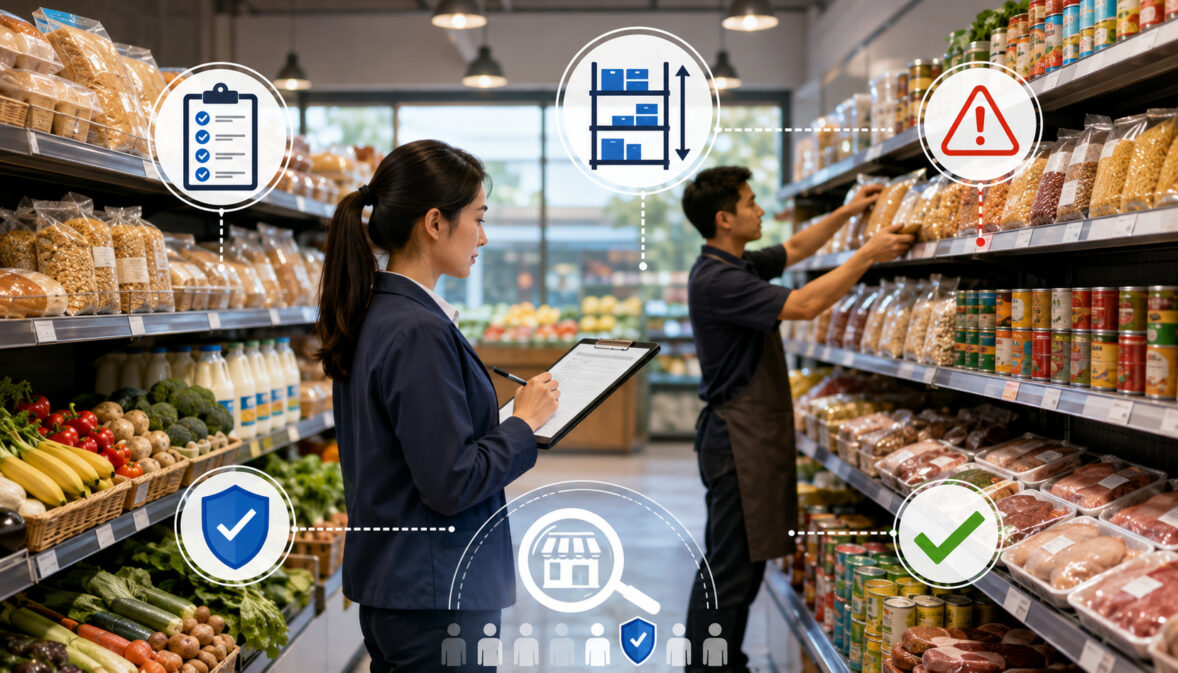
FNS may require a store visit before initial authorization or SNAP retailer reauthorization. The purpose is to verify whether the actual business matches the information supplied to FNS and whether the store satisfies program eligibility requirements.
Federal regulations expressly permit FNS to rely on visual inspections, sales records, purchase records, stockkeeping-unit counts, and other reasonable retail records.
A typical FNS SNAP inspection or site visit may therefore involve more than photographing shelves. Exact procedures can vary depending on the applicant and circumstances.
A practical authorization-visit workflow may include:
- The application and business information are reviewed.
- The physical store location and operating status are verified.
- Qualifying food inventory is observed.
- Staple-food categories and varieties are evaluated.
- Depth of stock is examined.
- Required perishable inventory is checked.
- Store layout, public sales area, hours, signage, or other business characteristics may be documented.
- Observations may be compared with the retailer’s application, invoices, sales information, and other records.
A store visit is evidence gathering. A shortage observed during the visit is important, but it should not automatically be treated as identical to a final SNAP application denial. The retailer should wait for and carefully review the formal FNS determination.
FNS Inspection Checklist for Retailers
Before any SNAP authorization inspection, managers should be able to answer the following questions based on normal operations:
- Are all required staple categories represented?
- Are there enough qualifying varieties in every category?
- Does every qualifying variety have sufficient depth?
- Are qualifying perishables present in the required number of categories?
- Are the products genuinely available for normal retail sale?
- Does the food inventory match what the business represented to FNS?
- Are store hours and the business location accurate?
- Is ownership and legal-entity information current?
- Are products reasonably stocked rather than hidden in inaccessible storage?
- Can the business produce legitimate invoices, receipts, purchase records, or other requested documentation?
- Is the store open and operating as represented?
- Do managers understand which products actually count?
What if Inventory Is Temporarily Low?
The current Criterion A regulation contains an important provision for temporary stocking shortfalls. If the store does not meet stocking requirements during an FNS visit, it may provide documentation showing that it ordered and/or received the required stock no more than 21 calendar days before the store visit. Examples include invoices and receipts.
That provision does not make continuous stocking optional. It recognizes that legitimate retail operations sometimes experience recent deliveries, sales, or stock disruptions. Failure to provide requested stocking documentation or failure to cooperate with an FNS store visit may result in denial or withdrawal.
Delivery delays, unusually strong sales, weather interruptions, supplier shortages, and seasonal conditions may explain low inventory, but a retailer should never assume FNS must disregard a shortage. Maintain records that show normal replenishment activity and respond exactly as directed.
Common SNAP Application Denial Reasons
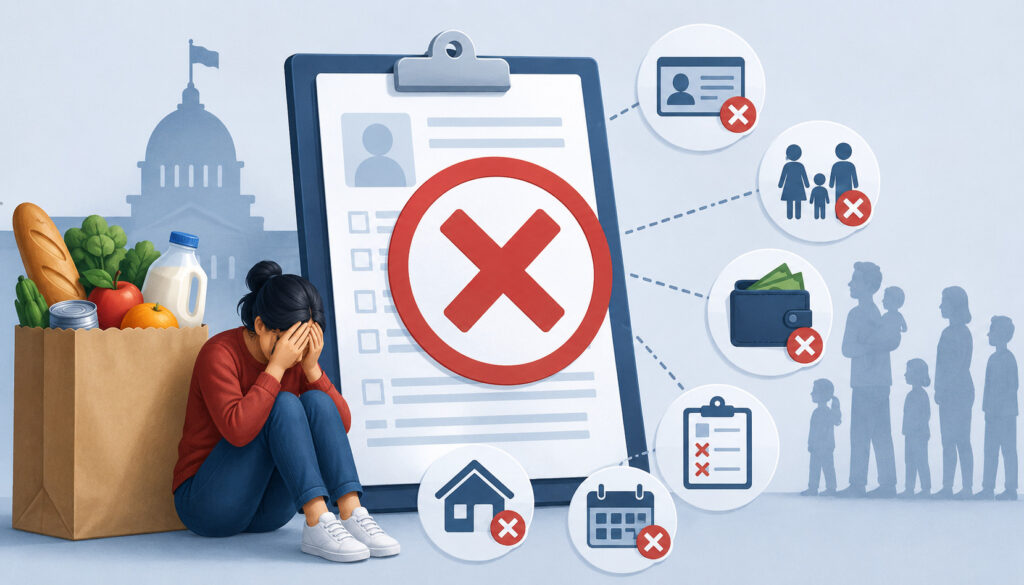
A SNAP application denial can result from more than a failed shelf count. Under 7 CFR § 278.1, FNS may deny authorization when a firm does not meet program qualifications, fails Criterion A or Criterion B, lacks required business integrity, provides materially false or misleading application information, fails to provide requested information, or otherwise does not satisfy the regulatory conditions for participation.
For stores applying under Criterion A, common inventory-related problems include insufficient staple-food varieties, inadequate depth of stock, too few qualifying perishable varieties, or mistakenly counting accessory foods and prepared foods toward the minimum.
Documentation problems can also matter. FNS may request state or local licenses, identification, leases, purchase records, sales records, invoice records, tax information, and other materials used to verify the legitimacy and accuracy of an application. Failure to comply with requested verification can result in denial.
Other SNAP retailer application denial reasons can involve the character of the business itself. A firm whose sales structure resembles a restaurant rather than an eligible retail food store may fail the applicable criteria.
Business-integrity concerns can lead to substantially different and sometimes longer denial periods. The regulation addresses criminal or civil judgments, removal from government programs, attempts to circumvent SNAP sanctions, prior violations, and other conduct bearing on the business integrity of owners, officers, or managers.
Failed Inspection vs. Formal Denial
Retailers should distinguish an inspection problem from an official adverse determination.
An inspector may document missing inventory, an apparent discrepancy, or a problem with the store’s circumstances. That observation becomes part of the information FNS may consider. The legally important document for appeal and next-step purposes, however, is the official FNS notice stating the agency’s determination.
Read that notice for:
- the precise reason for the action;
- the effective date;
- whether the action is a denial, withdrawal, or another determination;
- review rights;
- the deadline for exercising those rights; and
- instructions for submitting additional information, if applicable.
Do not rely on something an inspector allegedly said in conversation when the written determination says something different.
How to Fix a Failed FNS Inspection Lawfully
The safest way to fix a failed FNS inspection is to correct the actual operational deficiency, document the correction honestly, and follow the procedure FNS provides.
Buying temporary inventory solely to create an artificial inspection-day appearance is not a sustainable compliance plan, and false or misleading information can create a separate authorization problem.
Start with the official notice or request from FNS. Determine whether the agency is still gathering information, has asked for specific documentation, or has already issued a formal denial.
A practical workflow is:
- Read the official notice completely: Identify exactly what FNS found deficient.
- Map the deficiency to the current regulation: Determine whether the issue involves category, variety, depth, perishability, documentation, business structure, or another eligibility factor.
- Recount the store’s normal qualifying inventory: Do not count accessory foods, duplicate varieties, or products excluded under the current rules.
- Correct the deficiency as a permanent operational change: Add legitimate products, adjust reorder points, or improve supplier arrangements.
- Establish reliable replenishment: The inventory must be maintainable, not merely present for a photograph.
- Retain genuine purchase records: Keep invoices, purchase orders, delivery records, and other normal business evidence.
- Document internal compliance: Time-stamped internal photos and inventory reports may help management track conditions, although they do not replace records FNS specifically requests.
- Correct application information if necessary: Ownership, business structure, inventory, or sales information should accurately reflect current operations.
- Contact FNS through the channel listed in the notice.
- Use the specified review or reapplication process: Do not assume that fixing the shelves automatically reopens a denied application.
Fixing Depth-of-Stock Problems
Depth problems are usually operational. A retailer may carry seven legitimate varieties but repeatedly fall below three units of one or more high-turn products.
Create a compliance matrix listing each regulatory variety, the products used to satisfy it, current on-hand quantity, lead time, reorder point, and backup supplier. Set the internal reorder level above the federal floor.
For example, if three units are required, a store might internally reorder at five or six depending on customer demand and delivery frequency. The specific buffer is a business decision, not an FNS requirement.
Managers should also watch fast-selling items. Milk, bread, bananas, eggs, and other popular foods can be fully stocked in the morning and below minimum depth later that day. Compliance needs to fit actual sales patterns.
Fixing Perishable Inventory Problems
Perishables require a balance between compliance and shrink control. Choose qualifying products customers genuinely buy and build a regular replenishment cycle around them.
Use first-expiring, first-out rotation where appropriate, monitor refrigerator and freezer performance, remove expired or unsalable food promptly, and keep enough usable inventory to remain above required levels.
Supplier reliability matters. A single weekly delivery may create avoidable shortages if one distributor frequently shorts orders. Smaller stores may benefit from a qualified backup supplier for critical staple categories.
Never treat expired, spoiled, or otherwise unsalable inventory as a compliance cushion. The rule concerns products offered for normal retail sale.
SNAP Authorization Re-evaluation, Administrative Review, and Reapplication
There is no universal rule guaranteeing that a store that corrects its shelves will receive an automatic second FNS store visit. What happens depends on where the application stands, why FNS took action, and the instructions in the retailer’s official notice.
If the application is still being processed and FNS requests records or clarification, provide the requested material through the specified channel. If FNS has issued a formal adverse determination, different rules apply.
Administrative Review and Appeal Rights
A denial of an application or withdrawal of SNAP authorization under § 278.1 is subject to administrative review under 7 CFR Part 279.
Retailers seeking review of an eligible adverse determination should consult the administrative and judicial review rules in 7 CFR Part 279 and follow the instructions in their FNS notice.
Because this deadline is short, a retailer considering a failed USDA store inspection appeal should read the notice immediately rather than first spending weeks changing inventory.
A request for review must identify the administrative action and contain or later provide the information supporting the retailer’s position under the procedures in Part 279. The designated reviewer may sustain a denial or withdrawal, shorten the period for which it remains effective, or reverse the action.
An administrative review is not simply a request to receive another inspection. Its purpose is to review the agency action based on the record and supporting information.
Reapplying for SNAP Authorization
A retailer denied because it does not qualify for participation or fails Criterion A or Criterion B generally cannot submit a new SNAP application for at least six months from the effective date of the denial. This is why retailers should not assume that a stocking denial can be cured by immediately submitting another application.
Different denial grounds can carry different periods. Business-integrity findings, previous program sanctions, materially false information, or attempts to circumvent sanctions may produce longer or even permanent consequences under the applicable provisions.
Before reapplying for SNAP authorization, correct the original problem genuinely. A store previously denied for inventory should conduct a complete current-rule audit, establish sustainable purchasing, verify normal shelf and backstock levels, and assemble legitimate supporting records before filing again.
Reapplication is a new eligibility process; it is not a promise that FNS will accept evidence merely because stock has increased. Another store visit or additional verification may be required.
Inventory Documentation and a SNAP Stocking Matrix
Good documentation helps a retailer understand its own compliance and respond efficiently if FNS requests evidence. Federal regulations allow FNS to examine purchase records, sales records, invoice records, tax records, licenses, leases, and other information relevant to retailer authorization.
That does not mean every retailer must create an elaborate compliance binder in a specific unofficial format. It means ordinary business records should be accurate, accessible, and consistent with the store’s representations.
Useful records can include:
- supplier invoices;
- purchase orders;
- receiving or delivery records;
- inventory reports;
- current qualifying-food lists;
- sales reports;
- supplier account statements;
- product lists and UPC information;
- relevant business licenses; and
- internal inspection or stocking logs.
Never fabricate invoices, alter purchase dates, or obtain products solely to create a misleading impression for FNS. False or misleading application information can itself support denial or other enforcement consequences.
Invoice Requirements and Supplier Records
Retailers should avoid calling a particular invoice layout “mandatory” unless FNS has specifically required it. Different legitimate wholesalers, cash-and-carry suppliers, farms, and distributors use different record formats.
What matters is whether records credibly show normal business purchases and contain enough information for the relevant purpose. When FNS requests a specific record or format, follow that request.
For the special 21-day recent-stock provision, the regulation expressly mentions documentation such as invoices and receipts showing that required stock was ordered and/or received within the specified period before the visit.
Maintaining a SNAP Stocking Matrix
A simple internal matrix can help managers separate regulatory varieties from POS SKUs:
| Category | Qualifying Variety | Units on Hand | Perishable? | Reorder Point | Last Checked |
| Protein | Example qualifying variety | 6 | Yes/No | 5 | Date/time |
| Protein | Example qualifying variety | 8 | Yes/No | 5 | Date/time |
| Grains | Example qualifying variety | 7 | Yes/No | 5 | Date/time |
| Vegetables/Fruits | Example qualifying variety | 9 | Yes | 6 | Date/time |
| Dairy | Example qualifying variety | 5 | Yes | 5 | Date/time |
This is an internal compliance tool, not an official FNS form. Managers should customize it to actual qualifying foods and current regulatory classifications.
Maintaining SNAP Inventory Compliance After Authorization
SNAP retailer eligibility is not merely an application-day test. Authorized stores can be required to undergo periodic SNAP retailer reauthorization, and FNS may withdraw authorization when a store no longer meets applicable eligibility requirements.
That makes Maintaining SNAP inventory compliance an ongoing operating responsibility.
A practical maintenance system is:
- Identify the exact products used for each qualifying variety.
- Set a minimum internal stock level above the regulatory floor.
- Check staple categories and depth at least weekly, and more frequently for fast-selling products.
- Monitor perishable inventory and expiration dates.
- Replenish qualifying foods before normal sales take inventory below safe operating levels.
- Retain supplier records consistently.
- Train managers and ordering employees on current category and variety rules.
- Conduct periodic internal mock inspections.
- Recheck FNS requirements when regulations or product classifications change.
A useful SNAP stocking compliance table looks like this:
| Review Area | What to Verify |
| Criterion A/B | Know which eligibility pathway supports the store |
| Staple categories | All four are properly represented if relying on Criterion A |
| Required varieties | Seven qualifying varieties in each category under the current Criterion A text |
| Depth of stock | At least three legitimate stocking units per qualifying variety |
| Perishable foods | At least one perishable variety in three categories |
| Accessory foods excluded | Snacks, condiments, soda, candy, and other accessory foods are not being counted |
| Inventory available for sale | Qualifying stock is genuinely offered to customers |
| Supplier records | Invoices and receiving records are organized |
| Store information current | Ownership, location, and operating information remain accurate |
| Staff training | Managers know how to identify compliance-critical inventory |
| Internal checks | Routine reviews catch shortages before they become persistent |
Convenience Stores, Small Markets, Seasonal Stores, and Rural Retailers
Convenience stores often face a harder inventory-planning problem than full-line supermarkets. Shelf space is limited, snack and beverage sales can dominate, dairy refrigeration may be small, and slow-moving staple foods can create carrying costs or spoilage.
The answer is not cosmetic shelf placement. Retailer eligibility needs to shape assortment planning.
A small store should identify seven defensible varieties in each category, confirm that those foods count under the current variety framework, select products appropriate for local customer demand, and keep enough depth to survive ordinary daily sales.
The new variety framework includes several pathways intended to make category compliance more workable. For example, the rule provides specific treatment for whole-grain and non-whole-grain bread and pasta, breakfast cereals, shredded and non-shredded cheese, certain single-ingredient foods, shelf-stable proteins, and plant-based alternatives.
Seasonal and rural stores may face additional supplier constraints, long lead times, weather-related transportation problems, higher minimum orders, or less frequent deliveries. Those operational realities make reorder buffers and backup sourcing more important.
They do not create an automatic exemption from FNS stocking requirements. FNS does have authority to consider “need for access” in qualifying cases where an applicant fails Criterion A and Criterion B, but the decision belongs to FNS and depends on the circumstances.
For seasonal stores, inventory should match the periods in which the business represents itself as open and operating. For rural stores, choosing shelf-stable staple foods for nonperishable varieties while using dependable fresh or frozen products for the required perishable categories can help reduce waste without weakening compliance.
EBT Equipment After FNS Approval and Keeping Store Information Current
After authorization, a merchant still needs a functioning method to process SNAP EBT transactions. That technical setup can involve an EBT-capable terminal or POS platform, a payment processor, PIN-entry capability, network certification, and configuration appropriate to the merchant’s environment.
The sequence should remain clear:
FNS Authorization → EBT Merchant Setup → Approved Terminal/POS Configuration → Test/Activation → SNAP Transactions
Stores can also review how to manage EBT transactions with a POS system after the appropriate authorization and processing setup are complete.
After FNS authorization, merchants can review how to transition to EBT payment processing and prepare their POS environment.
State EBT administration is also distinct. States and their EBT contractors operate benefit-delivery infrastructure, while FNS determines whether an ordinary retail food store qualifies to participate as a SNAP retailer.
Retailers should also keep their FNS information accurate. Federal regulations require periodic reauthorization when requested and allow FNS to require updated application information. Failure to cooperate with reauthorization can result in withdrawal.
Changes in ownership, legal entity, store location, closure status, or major operating model should be handled according to current FNS instructions rather than assumed to transfer automatically with an existing authorization.
A new owner, for example, should not assume that purchasing a store also transfers the former owner’s SNAP authorization. When ownership or business structure changes, contact FNS through official channels and follow the applicable retailer procedures before processing benefits under changed circumstances.
Common FNS Stocking Mistakes and Questions to Ask FNS
Many SNAP store denial reasons begin with basic classification mistakes rather than a complete lack of food.
One recurring error is counting brands as separate varieties. Another is assuming flavors automatically qualify separately. Current regulations generally say differences in brands, flavorings, packaging, and preparation do not by themselves create distinct varieties unless a special rule applies.
Other mistakes include:
- counting accessory foods as staple varieties;
- having enough varieties but fewer than three stocking units of one or more;
- overlooking the three-category perishable requirement;
- relying on an outdated three-variety retailer checklist;
- stocking required foods only shortly before an expected visit;
- treating WIC inventory rules as SNAP rules;
- assuming any SNAP-purchasable item counts for Criterion A;
- failing to retain normal purchase documentation;
- allowing qualifying inventory to disappear after authorization;
- counting damaged or unsalable items;
- confusing a POS provider’s approval with FNS authorization; and
- failing to review a formal denial notice before a deadline expires.
Because the current retailer standards have recently changed, asking FNS a precise question can be more useful than relying on an old internet summary.
Questions worth asking include: Which criterion is being used to evaluate our store? Which current staple-food categories apply? How many varieties and stocking units are required at the relevant stage of our application? Does this particular product count as a distinct variety? Does it meet the perishable definition? Why was our application denied? Is FNS still accepting additional information? Do we have administrative-review rights? What is our filing deadline? When are we eligible to reapply? Will another store visit be necessary? What supporting records does FNS want?
Frequently Asked Questions
What are FNS staple-food stocking rules?
The FNS stocking requirements determine whether a retail food store relying on Criterion A carries enough qualifying staple food to participate in SNAP.
Current 7 CFR § 278.1 requires seven distinct varieties in each of four staple categories, three stocking units of every variety, and one perishable variety in three different categories. That equals at least 28 varieties and 84 stocking units.
The updated regulatory framework became effective July 7, 2026, with USDA establishing November 4, 2026 as the deadline for retailer implementation and enforcement of the expanded variety provisions.
How much food must a store stock to accept SNAP?
For a store qualifying under current Criterion A, the regulatory minimum is 28 qualifying staple-food varieties: seven varieties in each of four categories. Each variety requires at least three stocking units, making the minimum depth 84 units. At least one qualifying variety in three different categories must be perishable.
Those numbers are only minimums. A store needs enough ordinary inventory and replenishment capacity to remain compliant while customers buy products throughout the business day.
What does depth of stock mean for SNAP retailers?
Depth of stock refers to the number of units available for each qualifying staple-food variety. Current Criterion A requires three stocking units for every qualifying variety.
USDA describes a stocking unit as the form in which the product is normally sold, such as a can, bag, box, bunch, package, or an individual item commonly sold singly. A retailer cannot reasonably turn one normal retail package into several artificial units merely to satisfy the requirement.
What are the SNAP staple-food categories?
Current federal regulations identify four staple-food categories: protein, including plant-based sources; grains; vegetables or fruits; and dairy, including plant-based alternatives.
Older educational material may use earlier labels such as meat/poultry/fish and breads/cereals. Retailers evaluating current applications should rely on the current regulation and FNS instructions, especially during implementation of the updated variety framework.
What counts as a variety under FNS rules?
The default rule generally distinguishes foods by kind of plant, kind of animal, or main ingredient. Different brands, flavorings, package sizes, and preparation styles ordinarily do not create separate varieties by themselves.
The regulation also creates specially designated varieties for certain foods, including eggs, breads, pasta/noodles, cereals, cheeses, yogurt, sour cream, milk products, and other specified foods. Because those exceptions matter, a retailer should verify uncertain products before relying on them in its compliance count.
What are the perishable-food requirements?
Under current Criterion A, at least one qualifying variety must be perishable in three different staple-food categories. Because each qualifying variety needs three stocking units, at least nine minimum stocking units must be perishable.
FNS guidance describes perishables as qualifying fresh, frozen, or refrigerated foods, or foods that would spoil or substantially deteriorate within a short period at room temperature. Shelf-stable food does not become perishable simply because it requires refrigeration after opening.
Do snack foods count toward SNAP retailer stocking requirements?
Generally, no. The current accessory-food rules expressly exclude many chips, pretzels, crackers, popcorn, candy, snack bars, desserts, jerky, soda, condiments, sweeteners, oils, and related products from staple-food calculations.
Some of those products may still be purchasable by a SNAP household. That illustrates the important difference between SNAP purchase eligibility and whether a product counts toward the store’s retailer-authorization inventory.
Can a store fail an FNS inspection for low inventory?
Yes. Insufficient qualifying inventory can support a finding that a store does not meet Criterion A. FNS can assess inventory visually and through sales, purchase, and other business records.
Current regulations also allow a store that is short during a visit to provide documentation showing that required stock was ordered and/or received no more than 21 calendar days before the visit. That provision should not be treated as permission to operate below the continuous stocking requirement.
What are common SNAP application denial reasons?
Common reasons include failing Criterion A or Criterion B, inadequate qualifying inventory, insufficient documentation, inaccurate application information, failure to respond to FNS requests, or broader eligibility and business-integrity problems.
FNS may also deny firms that do not satisfy the applicable definition and purpose of a SNAP retail food store. The official denial notice controls. Retailers should identify the specific regulatory basis rather than assuming every denial resulted from a store inspection.
What happens after a failed SNAP store inspection?
A problematic store visit does not necessarily equal a final denial. FNS may review the inspection observations alongside the application, invoices, sales records, purchase records, and other information before making its determination.
If FNS formally denies the application, it must provide notice of the action and advise the firm about review rights. Read that notice immediately because administrative-review deadlines can be short.
Can a retailer fix inventory problems and be reinspected?
A retailer can and should correct genuine inventory deficiencies, but there is no general promise of an automatic reinspection. The next step depends on whether the application is still pending, additional documentation has been requested, a final denial has already been issued, or the retailer is later reapplying.
Contact FNS using the instructions in the official correspondence. Do not assume that sending new photographs or purchasing additional products automatically reopens a completed determination.
Can a denied SNAP retailer appeal?
A denial or withdrawal under § 278.1 generally qualifies for administrative review under 7 CFR Part 279. The current rule generally requires a written request within 10 days after delivery of the adverse-action notice, subject to the regulatory method for computing that period.
Because the deadline is strict and the notice may contain case-specific instructions, a retailer considering review should act promptly and follow the notice rather than relying solely on a general online guide.
How soon can a store reapply for SNAP authorization?
For a denial based on failure to qualify or failure to meet Criterion A or Criterion B, the current regulation establishes a minimum six-month period from the effective date of denial before a new application may be submitted.
Other grounds can result in different periods, including substantially longer periods for certain business-integrity issues. There is therefore no universal reapplication timetable for every SNAP denial.
How should retailers document qualifying inventory?
Maintain normal, legitimate business records such as supplier invoices, purchase orders, receiving records, inventory reports, sales reports, and current qualifying-product lists. FNS may request various business and inventory records when determining eligibility.
An internal stocking matrix can also help managers monitor category, variety, depth, perishability, and reorder points. It is a management tool rather than an official substitute for any FNS-required form or evidence.
How can a store maintain SNAP stocking compliance year-round?
Start by identifying the products that legitimately satisfy every required variety. Set reorder points above the three-unit minimum, monitor fast-selling staple foods frequently, rotate perishables, retain purchase records, train managers, and periodically perform a mock FNS inventory count.
Also review current USDA guidance when regulations change. The final rule revising the variety framework demonstrates why a checklist that was accurate in the past may no longer describe the requirements a retailer must prepare to satisfy today.
Conclusion
Meeting FNS stocking requirements involves much more than carrying products that happen to be SNAP eligible. Stores relying on Criterion A must organize inventory around qualifying staple-food categories, legitimate regulatory varieties, sufficient depth of stock, required perishables, and continuous availability.
Under the current regulatory framework, Criterion A calls for seven varieties in each of four staple categories, three stocking units per variety, and a qualifying perishable variety in three different categories. Criterion B provides a different path for stores whose staple foods account for more than 50% of total gross retail sales.
For independent retailers and convenience stores, the best compliance strategy is operational rather than cosmetic. Know which products count, keep a realistic buffer above minimum quantities, use reliable suppliers, monitor perishables, retain ordinary business documentation, train employees, and periodically check your inventory against current USDA requirements.
If a store visit identifies a shortage, do not attempt to manufacture a passing snapshot. Review the actual deficiency, preserve legitimate supplier records, make sustainable corrections, and follow the official FNS process.
If a formal SNAP application denial arrives, distinguish correcting the business from challenging the determination: administrative review has its own procedures and deadlines, while a new application may be subject to a waiting period.
Most importantly, keep authorization and processing separate. FNS decides whether the retailer may participate in SNAP. EBT processors and POS providers supply transaction technology after the authorization requirements are satisfied. A terminal can process technology; it cannot grant federal SNAP retailer status.